

Leaves in autumn: who is responsible — and who is liable if someone falls?
Wet leaves on the pavement are one of the most common causes of falls around a building in autumn — and just as with winter maintenance, the question of responsibility comes up quickly. Here is an overview of what owners, managing agents and tenants should know.
The legal basis: the duty to keep the way safe
Anyone who owns or manages a property has to ensure that it does not create an unreasonable danger for others — that is the core of what is known as the duty to keep the way safe (derived among other things from § 823 BGB). For pavements in front of your own property, many municipalities regulate this duty in the same street cleaning by-law that also covers winter maintenance — so the basic principles are the same as for winter maintenance (more on this in our article Clearing and gritting duty in Hesse).
Who exactly is responsible?
- Owners who live in the property themselves: primarily responsible for the pavement in front of their own property.
- Let properties: the duty can be transferred to the tenants in the tenancy agreement — but the landlord remains under a duty to check and supervise.
- Residents' associations:responsibility for communal areas lies with the WEG (the residents' association under German condominium law), or is passed on by the managing agent to a contractor — since the WEG reform of 1 December 2020 the association itself is the correct addressee, no longer the managing agent personally (see The WEG reform since 2020).
- Leaves from public trees: if they fall onto private land or the adjoining pavement, settled case law says the property owner still has to remove them to a reasonable extent.
How often does it have to be cleared?
There is no single deadline that applies throughout Germany — what counts is the relevant municipal by-law, and the courts have deliberately avoided prescribing a rigid frequency. As a rough guide, sweeping about once a week has become established for ordinary residential streets; the Landgericht Berlin (Berlin Regional Court) regarded the duty as fulfilled where sweeping had taken place six days before the accident. At particularly busy access points (entrances, steps, driveways) and in periods of heavy leaf fall, checks should be more frequent, because wet leaves become especially slippery there. Conversely, the duty only applies within what is reasonable: no court demands that every falling leaf be removed immediately, and in persistent wind repeated sweeping would be pointless anyway.
What happens if someone falls?
If a fall is demonstrably caused by a failure to clear leaves, the responsible party can be held liable under § 823 BGB for damages and compensation for pain and suffering. The individual case is always decisive — courts examine, among other things, how much of a hazard the leaves actually were and whether the usual standard of care was met. It counts in favour of the responsible party that passers-by have to expect leaves in autumn and adjust their behaviour accordingly; contributory negligence reduces liability correspondingly.
Practical tip
A fixed, documented cleaning schedule (for example weekly, with proof of date and time) is the most important evidence in a dispute that the duty to keep the way safe has been met — and that is exactly what the visit reports in the Zamsa customer portal produce automatically.
How Zamsa helps
For us, clearing leaves is a fixed part of grounds maintenance — on a regular schedule through the autumn months rather than ad hoc, with entrances, steps and driveways as the focus. Every visit is documented with a date and a photo in the customer portal, so the proof is there before it is needed. If cutting back is due anyway, it is worth looking at the statutory deadlines for it: Hedge-cutting deadlines: what the law allows between March and September.
The deadlines and rules mentioned here are general practical guidance and are no substitute for checking the municipal by-law that applies in each case, or for legal advice on the individual case.
Sources
- § 823 BGB – liability in damages
- Haufe – autumn leaves: duty to keep the way safe, liability, responsibility of the WEG since the 2020 reform, clearing intervals (LG Berlin, LG Coburg, OLG Hamm)
- Rechtsanwaltskanzlei Kotz – duty to keep the pavement safe and the duty to remove fallen leaves (AG Bad Segeberg, with further references)
- mietrecht.org – transferring the duty to keep the way safe to the tenant
Not legal or tax advice
This article gives a general overview and is no substitute for individual legal or tax advice. Laws, deadlines and responsibilities can change and may differ in an individual case. For a binding assessment of your particular situation, please consult a solicitor or tax adviser, or the relevant authority.
You might also find this useful.
Spielplatzkontrolle in Wohnanlagen: Pflichten, Intervalle, Dokumentation
Read more
Planning your lawn care schedule (spring to autumn)
Read more
Hedge cutting deadlines: what is legally allowed between March and September
Read more
Growth over pavement and road: when owners have to cut back
Read more
Treppenhaus als Fluchtweg: Was darf dort stehen — und was nicht?
Read more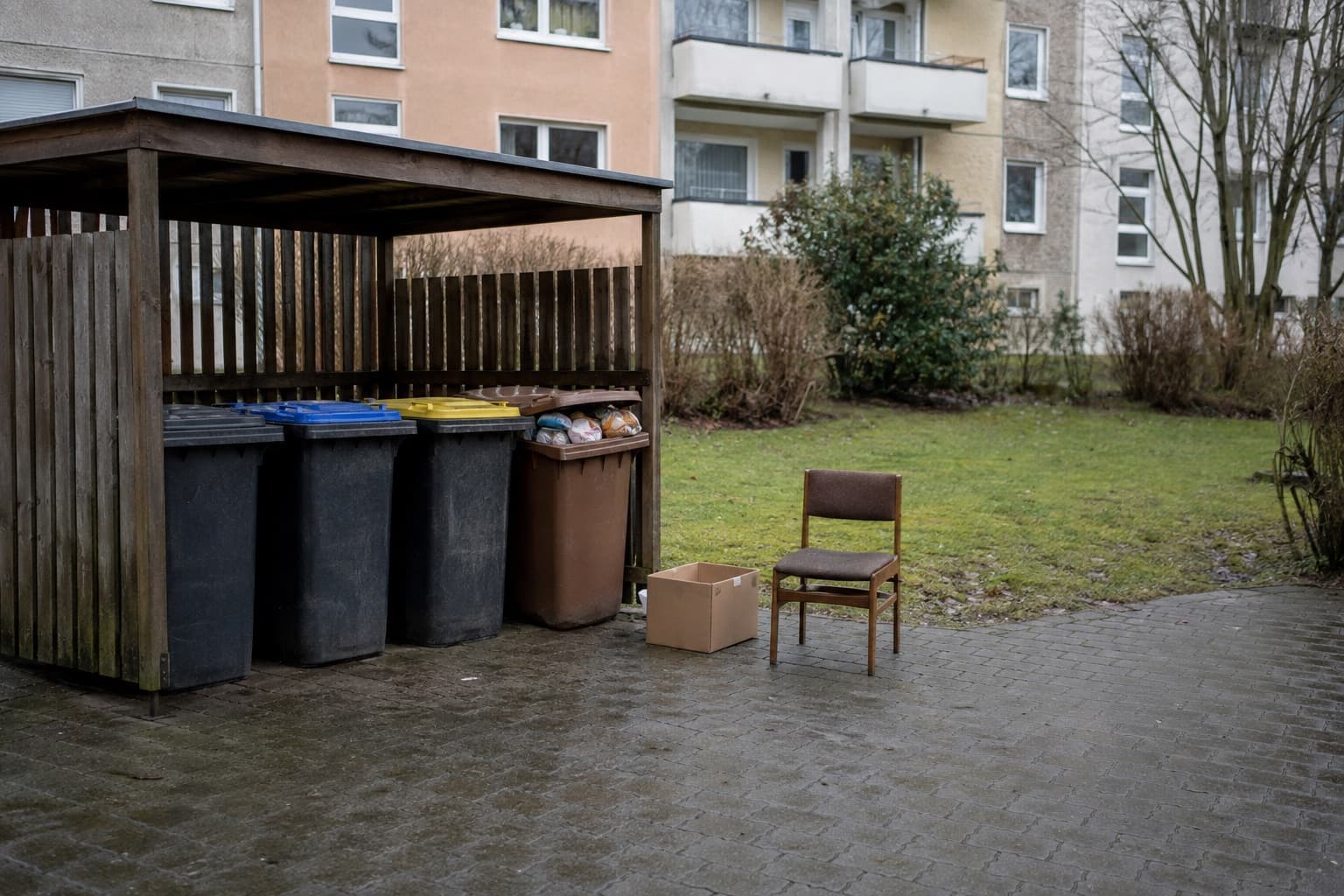
Müll im Mehrfamilienhaus: Was Fehlwürfe wirklich kosten
Read more
The clearing and gritting duty in Hesse — what owners and landlords need to know
Read more
Winter maintenance costs: what does the price depend on — and how do you save?
Read moreLet us talk about your property.
Tell us what you need — we usually reply within one working day with a quote, free and without obligation.
- 1


Send an enquiry
Through the contact form, by phone, WhatsApp or email — whichever suits you best.
- 2

Arrange a visit
We get back to you promptly and, where useful, arrange a visit on site that fits your schedule.
- 3


Receive a free quote
You get a transparent quote with no obligation — no hidden costs, no small print.
- 4


You decide
No pressure and no lengthy commitment: take your time to decide whether it is a good fit.