
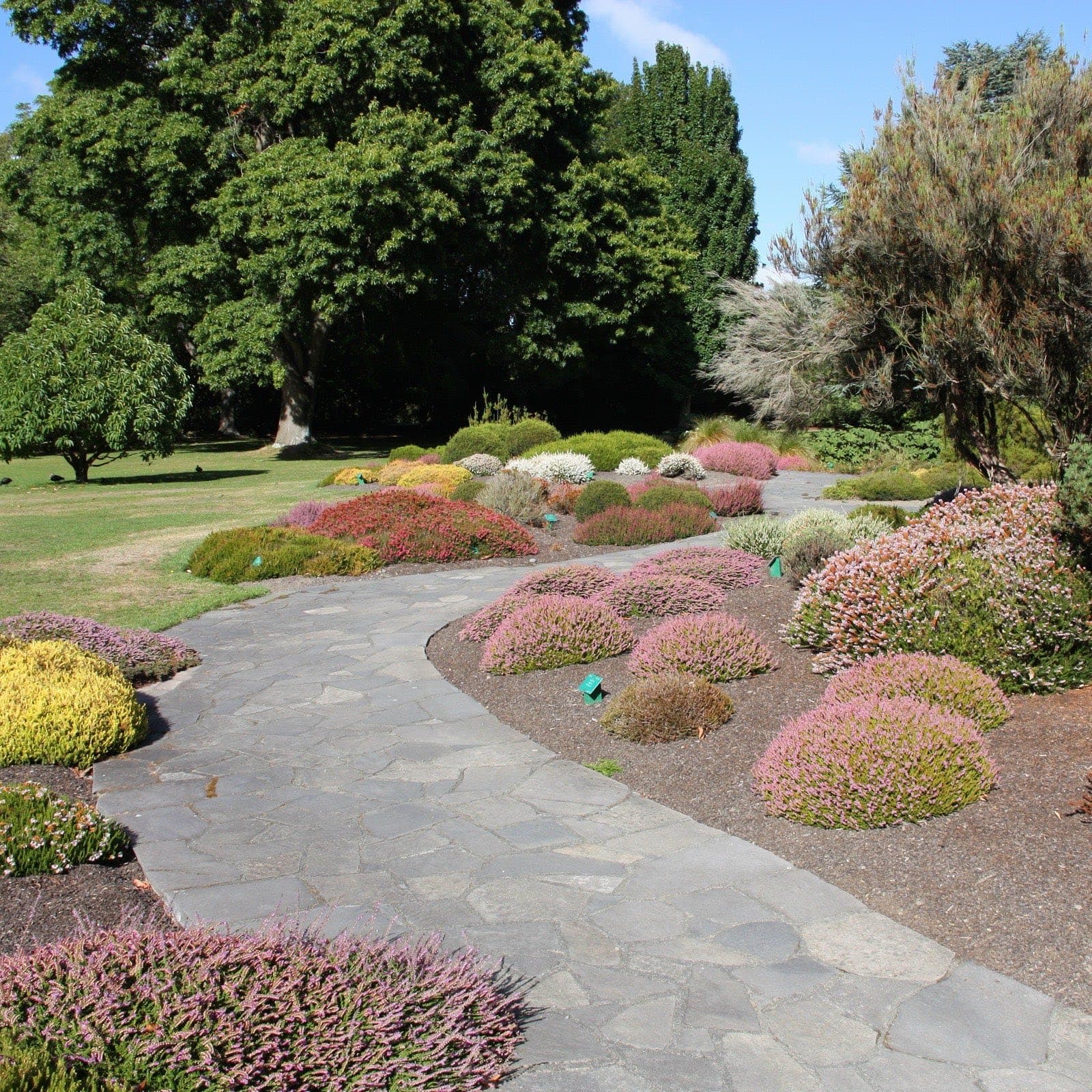
Growth over pavement and road: when owners have to cut back
In high summer growth is at its densest: hedges push out over the pavement, branches hang into the carriageway, a road sign disappears behind foliage. Many owners see cutting back as a matter of courtesy towards the neighbours. In law it is something rather different — a duty, and one you are liable for if you neglect it. Here is an overview of who is responsible, how much space has to stay clear and what happens if nothing is done.
Who has to cut back — the municipality or the owner?
The owner. Under § 27 Abs. 5 of the Hessian Roads Act (Hessisches Straßengesetz, HStrG), property owners have to remove growth that projects from their land onto public roads — pavements and cycle paths included. Hessian municipalities rely on exactly this provision when they issue notices to cut back, and they set out the details further in their street cleaning by-law or their hazard prevention order (Gefahrenabwehrverordnung). What matters is not where the plant is rooted, but where it grows: as soon as branches cross the boundary into public traffic space, the duty applies — even for a hedge that has stood unchanged in the same spot for thirty years.
How much space has to stay clear?
Each municipality sets the actual measurements itself, which is why they differ from place to place. The order of magnitude, however, is the same everywhere:
- Above pavements, Hessian municipalities require between 2.20 m and 2.50 m of clear height depending on the by-law — Freigericht states at least 2.20 m, Großkrotzenburg 2.30 m, Stockstadt am Rhein and Lauterbach 2.50 m.
- Above cycle paths the figure tends towards the upper end, often 2.50 m.
- Above the carriageway it is a uniform 4.50 m — this figure is identical in all the by-laws we checked, because it is based on the space needed by lorries, buses, refuse vehicles and emergency vehicles.
- On top of that, sight triangles at junctions and crossroads have to stay clear, and street lamps, road signs and house numbers must not be obscured.
If you want to know exactly, look up your own municipality's by-law — or work with the stricter figure. 2.50 m above the pavement and 4.50 m above the carriageway meets every one of the requirements listed above.
A common misconception
“I'm not allowed to cut at all from March to September” — every summer this sentence leads to growth reaching into the pavement for months on end. § 39 Abs. 5 Satz 1 Nr. 2 of the Federal Nature Conservation Act (BNatSchG) prohibits radical cutting back during this period in order to protect the breeding and rearing season. Satz 2 Nr. 2 Buchst. c, however, contains an exception for measures that serve to ensure road safety and that, in the public interest, cannot be carried out in another way or at another time. The municipality of Freigericht expressly points out to its residents that the necessary cutting back is therefore permitted during the breeding season as well. Independently of that, the protection of occupied nests under § 44 BNatSchG continues to apply — before cutting, a check is made for active nests. And a gentle shaping and maintenance cut that preserves the plant's form is possible all year round in any case; more on this in our article Hedge-cutting deadlines: what the law allows between March and September.
What happens if nothing is cut back?
As a rule, the municipality first sends a notice with a deadline. If it passes, the municipality has the growth removed itself by way of substitute performance (Ersatzvornahme) and invoices the owner for the cost — noticeably more expensive than commissioning a contractor yourself. Some municipalities punish breaches with a fine on top of that.
In financial terms, though, liability weighs more heavily. Anyone who breaches their duty to keep the way safe is liable under § 823 BGB for personal injury and property damage arising from it: the pedestrian who has to step out into the carriageway because of an overhanging hedge; the cyclist struck in the face by a branch; the accident at a junction whose sight triangle had become overgrown. That is precisely why cutting back is not cosmetic but risk prevention.
Two points that get overlooked in practice
- Letting the property does not change who the notice is addressed to:whether cutting back is agreed internally with tenants or with a contractor is a matter between the parties involved. The municipality's notice under road law is addressed to the owner — it remains their duty to make sure the work is actually carried out, and carried out in time.
- The problem grows slowly: a branch does not hang too low from one day to the next. A hedge encroaches on the clearance profile over two or three years without anyone noticing — which is why checking the height belongs in a fixed schedule rather than being left to chance. How regular checks pick up cases like this early is set out in Property inspections: why regular checks prevent consequential damage.
A workable rhythm
Two checks a year are enough for most properties: one in spring, before growth starts, and one in July or August, when growth is at its densest — that is the point at which municipalities send out their notices. If a heavy cut back is due that goes beyond keeping the traffic space clear, it is scheduled for the window from 1 October to the end of February. Two things then coincide: nature conservation law, and the time of year that is gentler on the plant.
How Zamsa helps
As part of our grounds maintenance we check the clearance profile along the pavement as well — and report it before the municipality does. We take care of the cutting back including removal of the green waste, in the district of Groß-Gerau, in Darmstadt, Neu-Isenburg, Oberursel and the surrounding area. Every visit is documented, so that in case of doubt there is proof of the condition the grounds were handed over in.
Sources
- § 39 Abs. 5 BNatSchG – ban on cutting back from 1 March to 30 September and exception for road safety
- § 44 BNatSchG – year-round protection of breeding sites and resting places
- § 823 BGB – liability in damages
- Gemeinde Großkrotzenburg – cutting back hedges, shrubs and trees (§ 27 Abs. 5 HStrG, clearance profile, substitute performance)
- Gemeinde Stockstadt am Rhein – guidance on the street cleaning duty and on cutting back
- Gemeinde Freigericht – removal of growth in the area of the pavements (as at July 2026)
- Kreisstadt Lauterbach – information sheet on cutting back into public traffic space
Not legal or tax advice
This article gives a general overview and is no substitute for individual legal or tax advice. Laws, deadlines and responsibilities can change and may differ in an individual case. For a binding assessment of your particular situation, please consult a solicitor or tax adviser, or the relevant authority.
You might also find this useful.
Spielplatzkontrolle in Wohnanlagen: Pflichten, Intervalle, Dokumentation
Read more
Planning your lawn care schedule (spring to autumn)
Read more
Hedge cutting deadlines: what is legally allowed between March and September
Read more
Leaves in autumn: who is responsible — and who is liable if someone falls?
Read more
Treppenhaus als Fluchtweg: Was darf dort stehen — und was nicht?
Read more
Müll im Mehrfamilienhaus: Was Fehlwürfe wirklich kosten
Read more
The clearing and gritting duty in Hesse — what owners and landlords need to know
Read more
Winter maintenance costs: what does the price depend on — and how do you save?
Read moreLet us talk about your property.
Tell us what you need — we usually reply within one working day with a quote, free and without obligation.
- 1


Send an enquiry
Through the contact form, by phone, WhatsApp or email — whichever suits you best.
- 2


Arrange a visit
We get back to you promptly and, where useful, arrange a visit on site that fits your schedule.
- 3


Receive a free quote
You get a transparent quote with no obligation — no hidden costs, no small print.
- 4


You decide
No pressure and no lengthy commitment: take your time to decide whether it is a good fit.