
Commissioning office cleaning: specification and cleaning cycle
“The office should be clean” is an understandable wish, but it is not a specification. When there is trouble over office cleaning, it is almost never because the cleaning was poor. Usually nobody ever wrote down what is done and how often. One person expects the kitchenette to be mopped every day, the other has planned it once a week. Both are right, because it is written down nowhere.
This article shows how to commission office cleaning so that the result can be checked: with room groups, a specification of services and a cycle that fits how the office is actually used. The basic types of cleaning are explained in our article Routine cleaning or deep cleaning?
Room groups instead of total floor area
A figure in square metres says little about how much work an office creates. An open-plan office with twenty desks and a washroom with four toilets have completely different needs. A useful specification therefore divides the space into room groups and sets separate tasks for each:
- Workstations: single offices and open-plan areas
- Meeting rooms: often used irregularly, but then with visitors
- Kitchen and kitchenette: sink, worktops, appliance fronts, waste
- Washrooms: toilets, basins, mirrors, consumables
- Entrance and corridors: the first impression for customers and visitors
The specification: task and frequency
For each room group, write down what is done and how often — daily, several times a week, weekly, monthly or as needed. Typical items are:
- Emptying waste bins and changing bin liners
- Vacuuming and damp-mopping floors
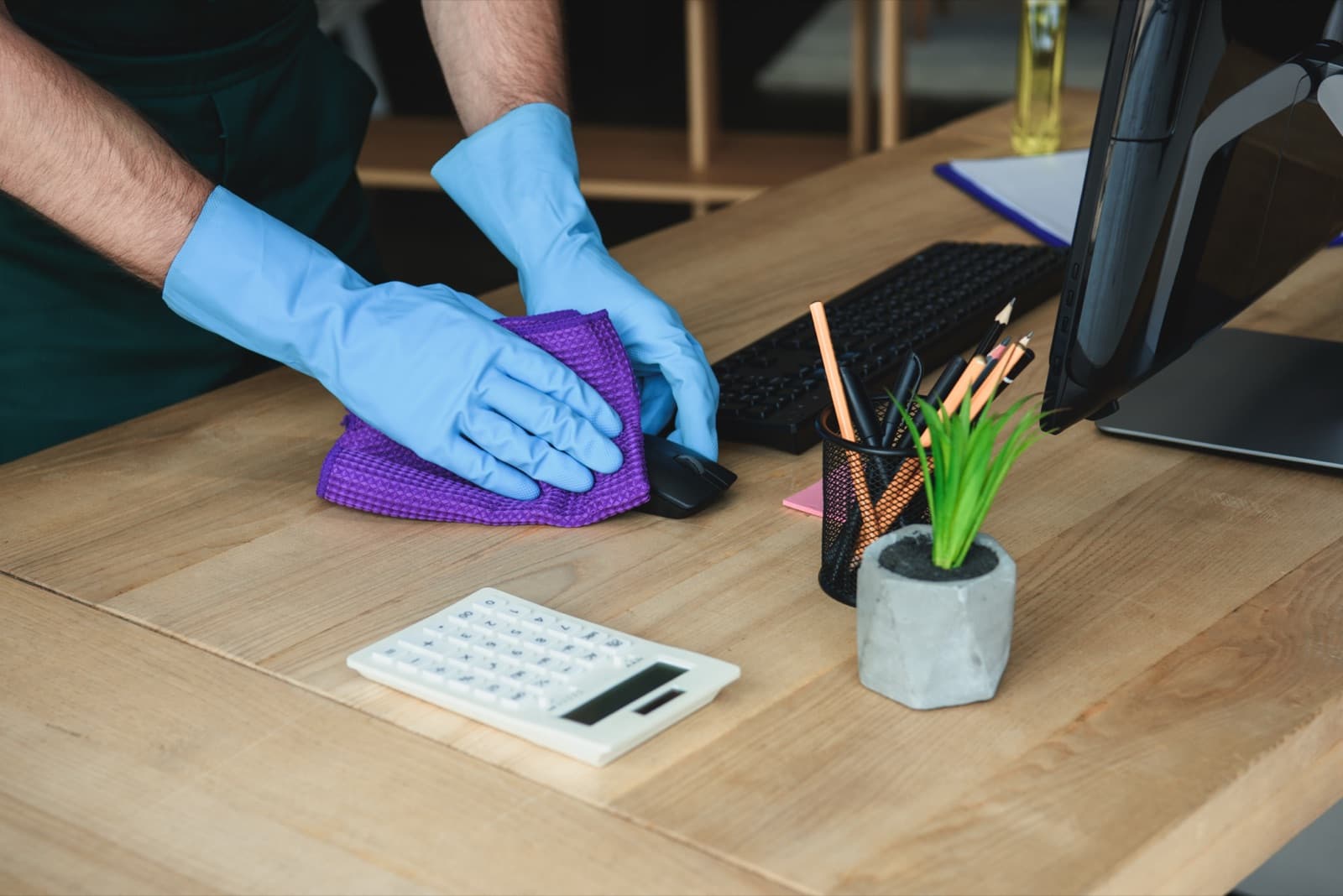
- Cleaning desk surfaces — only cleared surfaces, so nothing gets moved
- Wiping door handles, light switches and handrails
- Cleaning sanitary fittings and refilling consumables such as soap and paper
- Cleaning the sink, worktops and appliance fronts in the kitchen
- Removing fingerprints from glass entrance doors
What matters is that every line can be checked. “Mop floors twice a week” can be checked. “Keep the place clean” cannot.
How often is right?
There is no single figure that fits every office. The right cycle depends on use, not on floor area. These questions help you decide:
- How many people actually work on site, and on how many days?
- Do customers or visitors come regularly, and which rooms do they see?
- Is food prepared in the kitchen, or is it only used for coffee?
- How heavily are the washrooms used?
In practice, washrooms and the kitchen usually need a closer cycle than the workstations. Meeting rooms are often cleaned according to bookings rather than the calendar. Setting the cycle per room group means you do not pay for work that is not needed, and there is still no gap where it matters.
What is often forgotten
Some points only come up once cleaning has started. It is better to include them from the outset:
- Window cleaning and deep cleaning belong in the quote as separate items. They are not routine cleaning and have their own cycle.
- Access and keys: who gets a key or code, who locks up, who sets the alarm?
- Cleaning times: before work starts, after hours or during working time?
- Discretion: papers on desks are neither moved nor read. Put that explicitly into the agreement.
How to recognise a good quote
Quotes for office cleaning can only be compared if they describe the same service. A good quote shows this at first glance:
- A specification is attached, broken down by room group and frequency.
- There is a named contact person rather than a general hotline.
- Every visit is documented, so you can see what was done.
- It is clear how complaints are handled and how quickly work is redone.
- The notice period is stated clearly. What the contract term means for you is explained in our article Monthly notice or annual contract?
Without a specification you may end up comparing prices for different services. And if you also want to hand over caretaker work alongside the cleaning, check whether one contact for everything is simpler than several separate firms.
Checklist to print
- Room groups defined: workstations, meetings, kitchen, washrooms, entrance and corridors
- Tasks written down for each room group
- A frequency set for each task
- Cycle based on occupancy and visitors, not on floor area
- Window cleaning and deep cleaning as separate items
- Access, keys and locking up arranged
- Cleaning time agreed
- Handling of papers on desks recorded
- Contact person, proof of each visit and complaints procedure named
- Notice period checked
How Zamsa does it
We clean offices, shops and flats in Groß-Gerau and Darmstadt, on a regular or one-off basis. We use eco-labelled cleaning products, and every visit comes with a report including photos. That way you can see what was done even when you were not there. Our contracts can be cancelled monthly.
You can find everything else about our offer on our building cleaning page.
You might also find this useful.
Treppenhaus als Fluchtweg: Was darf dort stehen — und was nicht?
Read more
Stairwell cleaning: cycle, checklist, who is responsible?
Read more
Caretaker service vs. individual firms — what makes sense for managing agents?
Read more
Routine cleaning or deep cleaning? The difference — and how often each is needed
Read more
What may a caretaker do – and what not? Powers and limits in everyday practice
Read more
Property inspections: why regular checks prevent consequential damage
Read more
Spielplatzkontrolle in Wohnanlagen: Pflichten, Intervalle, Dokumentation
Read more
Müll im Mehrfamilienhaus: Was Fehlwürfe wirklich kosten
Read moreLet us talk about your property.
Tell us what you need — we usually reply within one working day with a quote, free and without obligation.
- 1


Send an enquiry
Through the contact form, by phone, WhatsApp or email — whichever suits you best.
- 2


Arrange a visit
We get back to you promptly and, where useful, arrange a visit on site that fits your schedule.
- 3


Receive a free quote
You get a transparent quote with no obligation — no hidden costs, no small print.
- 4


You decide
No pressure and no lengthy commitment: take your time to decide whether it is a good fit.