
Roof avalanches and icicles: when is the owner liable?
Does Hesse require snow guards on the roof? What courts have decided about roof avalanches and falling ice, and what owners can do when the thaw sets in.
After heavy snowfall the sun comes out, and the snow on the roof starts to move. If it slides onto a parked car, or an icicle hits someone at the front door, the question comes up quickly: is the owner liable? The courts are more restrained here than many people think, but not in every case. An overview of what applies in Hesse, what courts have decided and what owners can do when the thaw sets in.
Does Hesse require snow guards?
Not any more. The old Hessian Building Code (HBO) required devices against falling snow and ice where road safety called for them. That rule was dropped with the new Building Code of 28 May 2018. The state’s guidance on the Building Code makes clear, however, that the owner’s duty to keep the property safe for others (Verkehrssicherungspflicht) remains. Protective measures such as snow guards or canopies may still be required for reasons of safety.
If you read something different online, it is often about the rules of other federal states. Brandenburg, for example, makes snow guards mandatory, and in North Rhine-Westphalia they can be required. That does not apply in Hesse.
The basic rule of the courts
According to case law, owners have no general duty to protect others from roof avalanches. The Higher Regional Court (OLG) of Hamm, for example, said so in 2012. Protective measures are only needed in special circumstances. The courts look above all at:
- the general snow conditions in the area,
- the construction and location of the building,
- the safety precautions that are customary locally,
- the actual snow conditions on the day,
- the type and volume of traffic at risk.
The owner only has to warn if the danger cannot be recognised in time despite the care that can be expected of passers-by. Because in principle, the court said, everyone has to reckon with snow or ice falling from roofs in winter.
What courts have decided
- Car on the street, area with little snow: in 2023 the OLG Hamm saw no duty to fit snow guards because Essen is one of the areas with little snow. In such weather, everyone has to reckon with falling snow. Warning signs were not necessary either: the driver could have seen the snow-covered roof (11 U 67/22).
- Tenant’s car right against the wall of the house: in 2013 the OLG Düsseldorf found no duty to fit snow guards, again because the area has little snow. A warning sign would have added nothing, because snow was visibly lying on every roof. A landlord has no further-reaching duties than an owner who does not let the property (I-10 U 18/13).
- Snow guard in place: in 2014 the Local Court (AG) of Munich ruled that by fitting a snow guard the owner had fulfilled their duty. It is up to drivers to choose a safe parking space (274 C 32118/13).
- Car below a dormer: in 2025 the Regional Court (LG) of Traunstein dismissed the claim. The snow guards required by the building permit were in place, additional guards at the dormers were not necessary. Nor was a warning sign: the thaw was just as recognisable to the claimant, who could have parked further away from the roof. The OLG Munich confirmed this (6 O 1221/24 and 1 U 904/25).
- Hotel car park under the roof: the OLG Frankfurt am Main saw it differently in 2000. A hotel had set up guest parking spaces directly under the roof. When there was a risk of roof avalanches, it had to close them off or at least warn, because guests staying only briefly do not know the local weather (22 U 90/98).
What follows from this
The Frankfurt case shows where the risk lies: anyone who deliberately brings people under the edge of the roof, for instance with parking for customers, guests or visitors, has to act sooner when there is a risk of roof avalanches than someone whose house passers-by simply walk past.
And icicles?
For damage caused by parts of a building that come loose, § 836 BGB sets a stricter rule. According to the OLG Hamm, however, it does not apply to snow and ice on the roof: they are not “parts of the building”. What remains is the general duty of care under § 823 BGB.
We have not found a verified ruling specifically on icicles. It seems reasonable to assume that the same principles apply as for roof avalanches: what matters is whether the danger was recognisable and whether the owner could reasonably have done something about it. Icicles often hang where gutters overflow or are blocked, which is often right above entrances and footpaths. Why regular gutter care helps is explained in our article Cleaning gutters: how often, who is responsible and who pays?.
Snow load on flat roofs
With flat roofs and halls, the issue is less avalanches than weight. For structural design, Germany is divided into snow load zones. According to the assignment by the German Institute for Building Technology (DIBt), Darmstadt, the district of Groß-Gerau including Riedstadt and the district of Offenbach including Neu-Isenburg are in zone 1, Oberursel in the Taunus in zone 2.
The values of these zones are long-term averages and can be exceeded. The German Social Accident Insurance (DGUV) therefore describes what to do: the building operator has to establish in good time whether snow needs to be cleared. Before that, a clearing plan and a risk assessment are needed. Once the permissible additional load is exceeded, nobody may go on the roof any more, and nobody may stay in the building.
Safety first
According to the DGUV, rooflights and skylight strips are generally not safe to walk on and can hardly be seen under snow. Clearing a roof is therefore not a job for a ladder and a shovel, but for professionals who are secured against falls.
What owners can do when the thaw sets in
- Know the danger spots: building entrances, footpaths under the eaves, parking spaces and carports at the edge of the roof.
- Close off or warn where people do not expect the danger, above all where you yourself direct visitors. An owner may not close off a public street themselves, though, according to the OLG Hamm.
- Keep gutters clear, so that water does not overflow and freeze into icicles at the edge.
- Have snow guards checked if the roof is steep and ends directly above a footpath or entrance. That is a decision for a roofer, not for the caretaker.
- Assign tasks clearly: the duty of care can be transferred to others by contract. Whoever hands it over still keeps a duty to check and supervise. The Federal Court of Justice (BGH) confirmed this in 2008 (VI ZR 126/07).
How Zamsa helps
With our winter maintenance we keep footpaths, entrances and parking spaces clear and document every job in the customer portal. We check gutters and downpipes during the property inspection as part of our caretaker service. Anything we notice we report to you or the property management with a photo, so that it is dealt with before the winter. What the duties on the ground look like is explained in our article Liability for black-ice accidents without winter maintenance.
Sources
- Hessian Ministry of Economics – guidance on the HBO (HE-HBO), as of 1 April 2024, on § 35 (German)
- Hessian Building Code (HBO), consolidated version as of October 2025 (German)
- Baunetz Wissen – snow guards (rules in NRW and Brandenburg) (German)
- OLG Hamm, decision of 14.08.2012, I-9 U 119/12 (German)
- OLG Hamm, decision of 01.02.2023, 11 U 67/22 (German)
- OLG Düsseldorf, judgment of 06.06.2013, I-10 U 18/13 (German)
- AG München, judgment of 11.03.2014, 274 C 32118/13 (press release, German)
- LG Traunstein, judgment of 19.02.2025, 6 O 1221/24, confirmed by OLG München 1 U 904/25 (press release of 13.01.2026, German)
- OLG Frankfurt am Main, judgment of 27.04.2000, 22 U 90/98 (summary at dejure.org, German)
- BGH, judgment of 22.01.2008, VI ZR 126/07 (dejure.org, German)
- DIBt – assignment of wind and snow load zones by administrative area (German)
- DGUV Information 212-002 – clearing snow from roofs (German)
- § 823 BGB – liability in damages (German)
- § 836 BGB – liability of the owner of a plot of land (German)
Not legal or tax advice
This article gives a general overview and is no substitute for individual legal or tax advice. Laws, deadlines and responsibilities can change and may differ in an individual case. For a binding assessment of your particular situation, please consult a solicitor or tax adviser, or the relevant authority.
You might also find this useful.
Road salt, grit or granules: what is allowed on the footpath?
Read more
The clearing and gritting duty in Hesse — what owners and landlords need to know
Read more
Winter maintenance costs: what does the price depend on — and how do you save?
Read more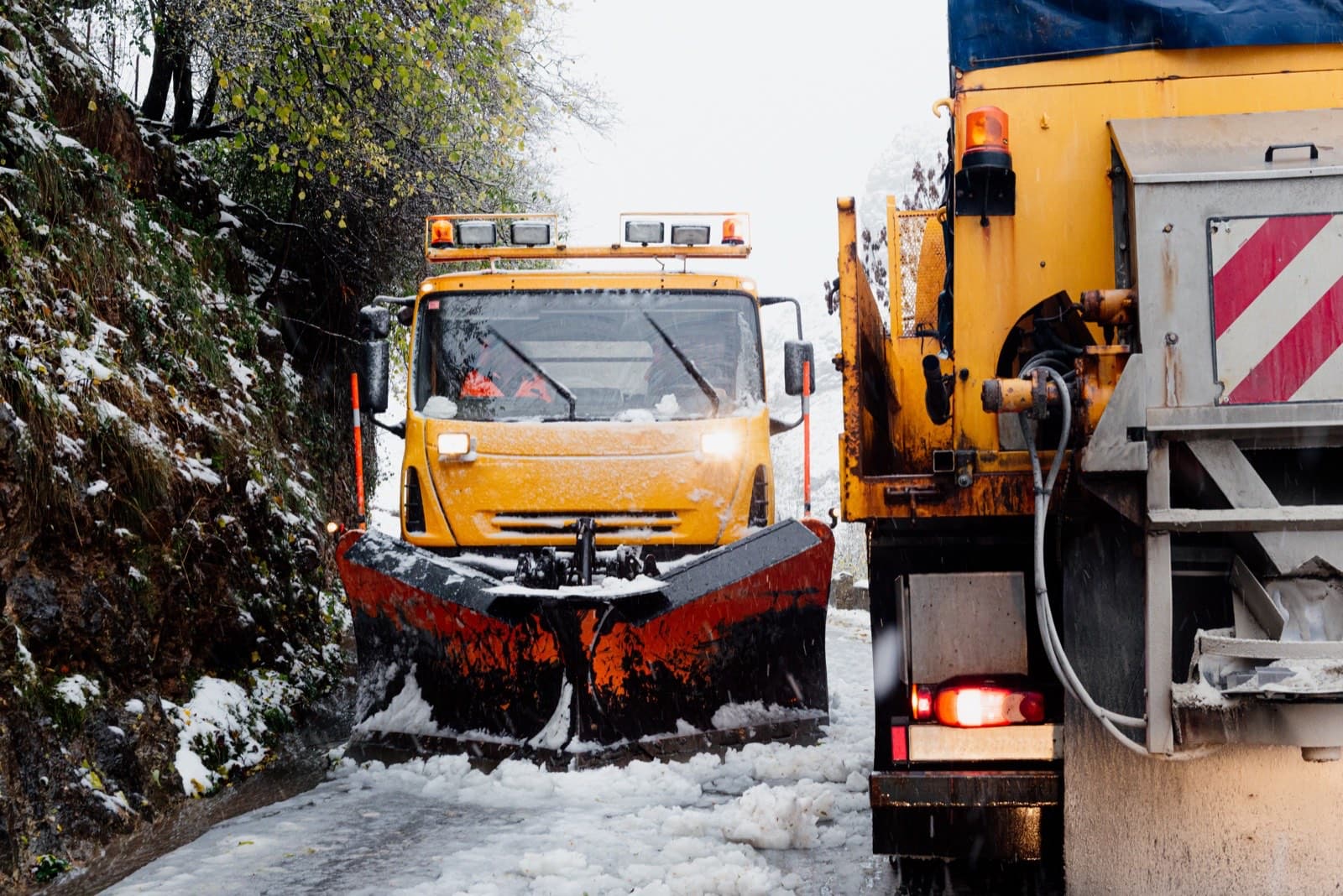
Liability for black-ice accidents without winter maintenance
Read more
Impregnating paving after stone cleaning: is it worth it?
Read more
Cleaning gutters: how often, who is responsible and who pays?
Read more
Felling a tree on your property: when is it allowed?
Read more
Window cleaning in apartment buildings: who cleans, who pays?
Read moreLet us talk about your property.
Tell us what you need — we usually reply within one working day with a quote, free and without obligation.
 Send an enquiryThrough the contact form, by phone, WhatsApp or email — whichever suits you best.
 2Arrange a visitWe get back to you promptly and, where useful, arrange a visit on site that fits your schedule.
 3Receive a free quoteYou get a transparent quote with no obligation — no hidden costs, no small print.
 4You decideNo pressure and no lengthy commitment: take your time to decide whether it is a good fit.